Uploading Sketch From Nano to Breadboard Arduino
From Arduino to a Microcontroller on a Breadboard
Migrating an Arduino board to a standalone microcontroller on a breadboard.
This tutorial explains how to drift from an Arduino lath to a standalone microcontroller on a breadboard. It's like to this tutorial, but uses an Arduino board to program the ATmega on the breadboard.
Unless you lot choose to use the minimal configuration described at the end of this tutorial, you'll demand iv components (besides the Arduino, ATmega328P, and breadboard):
-
a 16 MHz crystal,
-
a 10k resistor, and
-
two 18 to 22 picofarad (ceramic) capacitors.
Burning the Bootloader
If yous have a new ATmega328P (or ATmega168), you'll demand to burn down the bootloader onto it. You can practise this using an Arduino board as an in-organisation plan (ISP). If the microcontroller already has the bootloader on it (e.g. considering you took it out of an Arduino board or ordered an already-bootloaded ATmega), you tin can skip this section.
To fire the bootloader, follow these steps:
-
Upload the ArduinoISP sketch onto your Arduino board. (You lot'll need to select the board and serial port from the Tools menu that correspond to your board.)
-
Wire up the Arduino board and microcontroller as shown in the diagram to the right.
-
Select "Arduino Duemilanove or Nano w/ ATmega328" from the Tools > Board menu. (Or "ATmega328 on a breadboard (viii MHz internal clock)" if using the minimal configuration described beneath.)
-
Select "Arduino equally Internet access provider" from Tools > Programmer
-
Run Tools > Fire Bootloader
You should just need to burn the bootloader in one case. After yous've done and so, y'all tin remove the jumper wires connected to pins 10, 11, 12, and 13 of the Arduino board.
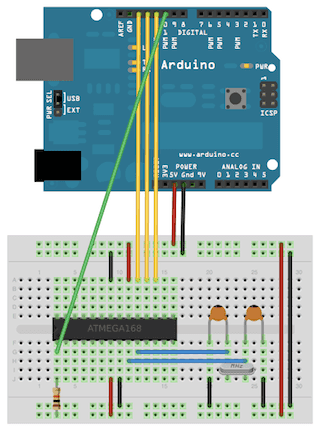
Using an Arduino lath to burn the bootloader onto an ATmega on a breadboard.
Uploading Using an Arduino Lath
One time your ATmega328P has the Arduino bootloader on it, you tin upload programs to information technology using the USB-to-serial converter (FTDI bit) on an Arduino board. To do, you remove the microcontroller from the Arduino board so the FTDI chip can talk to the microcontroller on the breadboard instead. The diagram at right shows how to connect the RX and TX lines from the Arduino lath to the ATmega on the breadboard. To program the microcontroller, select "Arduino Duemilanove or Nano w/ ATmega328" from the the Tools > Board menu (or "ATmega328 on a breadboard (eight MHz internal clock)" if you're using the minimal configuration described beneath). And then upload as usual.
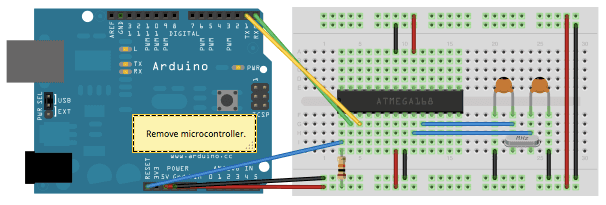
Uploading sketches to an ATmega on a breadboard. Remember to remove the microcontroller from the Arduino board!
Minimal Excursion (Eliminating the External Clock)
If you don't have the extra 16 MHz crystal and eighteen-22 picofarad capacitors used in the above examples, you can configure the ATmega328P to utilize its internal 8 MHz RC oscillator every bit a clock source instead. (You don't really need the 10K pullup resistor on the reset pin either, so nosotros remove it to get a truly minimal configuration.)
You'll need to install support for an additional hardware configuration:
-
Download this hardware configuration annal: breadboard-1-half dozen-x.zip, Breadboard1-5-10.zip or Breadboard1-0-x.zip depending on which IDE you use.
-
Create a "hardware" sub-folder in your Arduino sketchbook folder (whose location you can find in the Arduino preferences dialog). If you've previously installed support for additional hardware configuration, you may already have a "hardware" folder in your sketchbook.
-
Move the breadboard binder from the zip archive to the "hardware" folder of your Arduino sketchbook.
-
Restart the Arduino software.
-
You lot should run into "ATmega328 on a breadboard (8 MHz internal clock)" in the Tools > Lath menu.
Once y'all've done this, you tin burn the bootloader and upload programs onto your ATmega328P as described above. Be sure to select "ATmega328 on a breadboard (8 MHz internal clock)" when burning the bootloader. (If you select the incorrect item and configure the microcontroller to use an external clock, it won't work unless you lot connect one.)
Attention
This procedure works on Arduino 1.0.x software.
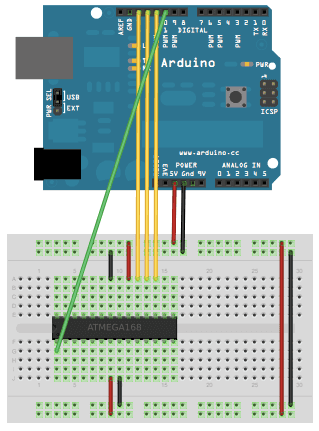
Using an Arduino board to burn the bootloader onto an ATmega on a breadboard (w/o an external clock).
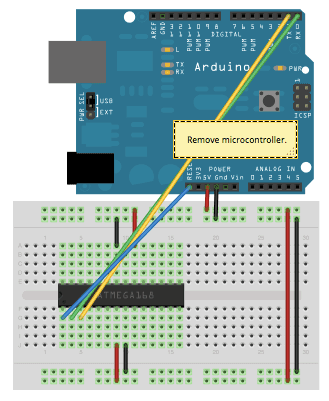
Uploading sketches to an ATmega on a breadboard.
Getting Rid of the Arduino Board
Once yous've programmed the ATmega on the breadboard, you tin can eliminate the Arduino. To do so, you'll need to provide an alternative power supply for the microcontroller. Encounter the standalone Arduino on a breadboard tutorial for details.
Learn more
Yous tin find more basic tutorials in the built-in examples section.
Y'all tin also explore the language reference, a detailed drove of the Arduino programming linguistic communication.
Source: https://docs.arduino.cc/built-in-examples/arduino-isp/ArduinoToBreadboard
0 Response to "Uploading Sketch From Nano to Breadboard Arduino"
Post a Comment